"A
Breath on Wings tune
review September 2018
"A Breath on Wings is one of those
tunes thath queeckly conjures interest- "it's impossible
to defy such patiently constructed melodies - but its yearning
songcraft is equally compelling" by The
Akademia, Los
Angeles
 Lovely
Tunes review Lovely
Tunes review
by Edward
Blanco at All About Jazz. March 2012
"...Leading off with a couple of originals ("Discovering
Your Secrets," "The First Day Of Love") set the
stage for forty minutes of relaxing, light jazz from the tender
touches of a pianist who prefers the warmth of lovely music to
the heat of a swinging affair. His renditions of Porter's "Easy
To Love" and Monk's classic "Ruby
My Dear" are
delicate intimate statements, while his own "July Bossa" provides
a brief glimpse of his quick right hand approach.
A musician with a preference for the softer side of jazz, pianist
Norberto Tamburrino offers a break from the boisterous
horns and saxophones, and the pounding sounds of the percussive
instruments, with a masterful solo piano performance of Lovely
Tunes that is
truly a pleasure to hear often.."
You can read the complete
review at All
About Jazz

 Giuseppe
Piacentino recommended this album
on Musica
Jazz #9 2011, Italy: Giuseppe
Piacentino recommended this album
on Musica
Jazz #9 2011, Italy:
"...quello
che colpisce della sua musica e' il non essere affatto
appiatita su Monk; tra l'altro, si
potrebbero nominare altre ascendenze, come Tristano,
il primissimo Bley,
Ran Blake, perfino Tatum e
cosi' via. L'orbita' monkiana e' forte, ma solo su
certe coordinate: il senso del pianoforte come strumento
percussivo, l'assenza delle mezze tinte (cosa che rende
davvero inconsueta la sua drammatica versione di Estate),
il gusto dell'iterazione e della dissonanza..."
Thanks
for the Riff from "I
nostri CD", Online Jazz.net
Review by Gerlando Gatto, April
2011
Ancora una prova superlativa
del pianista Norberto Tamburrino che attraverso undici brani evidenzia
tutta la maestria di un pianismo basato su una solida preparazione
di base e su una profonda conoscenza della letteratura pianistica.
In nove pezzi il musicista suona in splendida solitudine mentre
in due è accompagnato dal bassista
Francesco Mariella già con lui in precedenti fatiche discografiche
quali “Deco”, Splasc(H), “Reflection(s)
on Monk”, Philology,
“Revelations from the Sky”, Art Notes. Come nei precedenti
album, il grosso del repertorio (8 brani) è costituito da
originals di Norberto con l’aggiunta
di “Estate” di Bruno Martino, “Body & soul” e “Nutty” di
Thelonious Monk. Tamburrino affronta, quindi, ogni brano con lo
giusto spirito: così in “Estate” e in “Body & Soul” dà prova
allo stesso tempo di grande lirismo e di originalità mentre
il pezzo di Monk è l’ennesima
testimonianza dell’amore che Tamburrino nutre verso questo
grande maestro. Ma a conferma che il pianista conosce , come si
diceva, assai bene tutta la storia del piano jazz, nei due brani
che assieme a “Body & Soul” chiudono l’album,
vale a dire “2010 Itinerary” e “Free
Impro” scopriamo un Tamburrino quasi inedito lanciarsi in
improvvisazioni di chiaro sapore free, ma un free consapevole,
maturo, in cui si sa perfettamente cosa si sta facendo in ogni
attimo dell’esecuzione ..insomma
un free che ben si inserisce nella personalità di Norberto
a comporre un puzzle prezioso ed unico.
"Ascoltabile
Piano & Atmospheres", a very curated
review by fine American pianist Richard Henry from WorldWide
Jazz January, 6, 2011
"...Norberto’s
album Ascoltabile Piano and Atmospheres was released in 2010
and features 16 tracks of incredible solo piano playing. Piano
notes that seem to blend with one another are enhanced by the
sustain pedal in the beginning of the first track Ascoltabile
Piano. Norberto can play a series of notes together
cleanly, in rhythm and with amazing control. You can definitely
hear Monk’s
influence on his piano playing.
You can hear fourth chords at
the beginning before themomentum builds up. Low bass notes add
a resonance of sound. Dazzling runs are  played
on the piano. You can hear strong jazz harmony in the left hand.
The tempo speeds up as the harmonies blend together with the
sustain pedal. A constant motif is heard in the right hand at
times. An exciting broken chord starts the fourth track The
Real Illusion. Spectacular
runs are played with feeling as you can tell that Norberto is
expressing the music. Use of the bass notes in the chords add
support to the flexible right hand notes. This tune feels very
heart felt throughout. Incredible melodic inventiveness is heard
in the right hand. The dynamics are heard well with soft notes
heard on the ascending runs. Every tone is rich and is a treasure
to the ears. You experience a floating feel at the beginning of the eighth track
The Lake Atmosphere. When you listen to this tune,
you can tell that careful attention is paid to the notes and phrases, that produces
a tranquil atmosphere. This tune has a haunting, peaceful quality when you listen
to the dark harmonies. The runs in the right hand are never forced and always
feel musical. Space between the notes creates suspense and you wonder what you
will hear next. Towards the end you hear the tonality switching to major for
a short moment. A thoughtful sound fills your ears when you listen to the eleventh
track Dawn Atmosphere. Runs that begin in the low bass adds an astounding full
sound to this tune. A terrific ascending run is heard that reaches to the very
top. played
on the piano. You can hear strong jazz harmony in the left hand.
The tempo speeds up as the harmonies blend together with the
sustain pedal. A constant motif is heard in the right hand at
times. An exciting broken chord starts the fourth track The
Real Illusion. Spectacular
runs are played with feeling as you can tell that Norberto is
expressing the music. Use of the bass notes in the chords add
support to the flexible right hand notes. This tune feels very
heart felt throughout. Incredible melodic inventiveness is heard
in the right hand. The dynamics are heard well with soft notes
heard on the ascending runs. Every tone is rich and is a treasure
to the ears. You experience a floating feel at the beginning of the eighth track
The Lake Atmosphere. When you listen to this tune,
you can tell that careful attention is paid to the notes and phrases, that produces
a tranquil atmosphere. This tune has a haunting, peaceful quality when you listen
to the dark harmonies. The runs in the right hand are never forced and always
feel musical. Space between the notes creates suspense and you wonder what you
will hear next. Towards the end you hear the tonality switching to major for
a short moment. A thoughtful sound fills your ears when you listen to the eleventh
track Dawn Atmosphere. Runs that begin in the low bass adds an astounding full
sound to this tune. A terrific ascending run is heard that reaches to the very
top.
The direction of the notes have a tendency to reach upward, creating a brilliant
ladder of sound. He allows time between the notes that lets your musical imagination
flourish.
You can hear impressive descending runs in the right hand. A series of notes
that are alive with vigor is heard at the beginning of the fourteenth track The
London Trip Atmosphere. A strong downbeat in the low bass is played
with force and authority. Wonderful notes are played in the right hand that have
amazing creativity. Repeated notes are heard in the right hand while a series
of left hand chords add a rhythmic flavor of sound. There is a strong influence
of Monk in this tune. The complexity of the whole piece is unbelievable.
Notes that are played with much virtuosity in the right hand feature exhilarating
speed.
Norberto Tamburrino’s expertise of jazz piano
is felt strong in Ascoltabile Piano & Atmospheres. He has complete control
of the astounding complexity of his compositions. His improvisations lets your
mind enter into a fascinating realm of
sound. The music in this album gives your ears plenty to listen to with its lush
harmonies and dazzling runs.
He makes the most out of the versatility of the
piano.
His jazz harmony and improvised runs work together perfectly.
Ascoltabile Piano & Atmospheres is a must listen for jazz fans."
"Multiple Reviews: Norberto
Tamburrino Solo and Ensemble" by Bruce Lindsay, All
About Jazz
Pianist Norberto Tamburrino is based in
the sunny climes of southern Italy, but his jazz influences come
for the most part from the thriving US scene of the 1940s, 1950s
and 1960s. He's happy to credit Bud
Powell, Hank Jones, Lennie
Tristano and Art Tatum as
influences, but above all it's the influence of Thelonious
Monk that comes across most clearly in Tamburrino's playing.
Indeed, his 2009 album Reflection(s) On Monk (Philology
Jazz) was clearly influenced by, as well as being a tribute to,
the great musician. The spirit of Monk pervades Tamburrino's
playing again on the two albums reviewed here, but there is too
a strongly reflective and personal feel to his work.
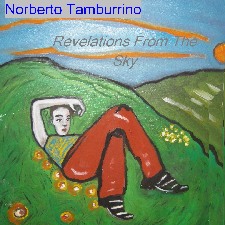 Norberto
Tamburrino Norberto
Tamburrino
Revelations From
The
Sky
Art
Notes Records
2010
Revelations From The Sky finds Tamburrino
playing in solo, trio and quartet formations, exploring a range
of moods and tempos. Monk's influence on Tamburrino's playing is
most obvious on the opening track, "Revelations From the Sky," which
sees the pianist's chordal playing underpinning the tune's dominant
musical force, the tenor sax of Roberto Spagnolo, while drummer
Marcello Nisi provides a slinky percussive beat. Spagnolo also
dominates "Praterie Dell'Infinito," while Tamburrino's own playing
is fluid and lyrical and bassist Francesco Mariella adds a strongly-played
bass solo. Monk's influence is less obvious here and as the album
progresses Tamburrino continues to focus on this more lyrical,
smoother stylistic approach.
Benny Carter's "When
Lights Are Low" is given an intriguing treatment. Initially the
Monk influence resurfaces and Tamburrino then alternates between
this angular, jagged approach and his more fluid playing across
the remainder of the tune. For "Indaffarato," Tamburrino is joined
by the rhythm section of Joseph Lepore on bass and Bruce
Cox on drums—both musicians played on Reflection(s)
On Monk. These experienced musicians bring a strength and
confidence to the music that is at times absent from the playing
of Nisi and Mariella—as a result Tamburrino's own playing
seems stronger and freer, creating the most complete tune on the
album.
The final three tunes are solo piano pieces. "Felinity" is
another tune characterized by angular playing and rhythmical changes, "Some
Brilliant Shadows" has a lovely, delicate melody and "The Son(g)
is Born" is a slow and beautiful ballad which sees Tamburrino in
a particularly reflective and gentle mood.
Norberto
Tamburrino
Ascoltabile Piano And Atmospheres
Art
Notes Records 2010
Ascoltabile Piano And Atmospheres was
recorded in Taranto, Italy, between December 2007 and December
2009 and showcases Tamburrino's solo piano—with the exception
of one track, "Is Atlantis On The Sky?," which features multi-tracked
electric piano and keyboards. The first seven tunes are compositions,
while the remainder are improvised pieces which Tamburrino refers
to as "Atmospheres."
The distinction between the composed and improvised
pieces is not always clear. "Ascoltabile Piano," for example, is
composed but its abrupt ending gives it the feel of an improvised
piece, while the structure of "Mad Wars Atmosphere" makes it
sound more like a composed tune. This lack of distinction is more
of an academic issue than an aesthetic one, for it makes no difference
to the experience of hearing the performances. The multi-tracking
on "Is Atlantis On The Sky?" gives the tune an ethereal choral
feel, but the overall effect tends to overwhelm the central theme
of the tune, played on electric piano. The solo piano tunes, whether
composed or improvised, are much more successful; Tamburrino connects
effectively with the acoustic instrument, producing attractive,
thoughtful performances across a series of brief and reflective
pieces.
The overarching impact of Ascoltabile Piano
And Atmospheres is a gentle one. The variations in tempo
and mood to be found on Revelations From The Sky are
absent here and the result is a far more consistent experience.
Tamburrino's playing is emotive and thoughtful, and the tunes
fit together to create a quietly contemplative album.
"Ascoltabile Piano & Atmospheres" by Luca
Labrini, JazzItalia
"..Sicuramente
un lavoro riuscito che rappresenta un tassello importante nella discografia
del pianista pugliese in una dimensione in cui a venir fuori è proprio
il gusto e fraseggio di Tamburrino, che si conferma un artista completo.
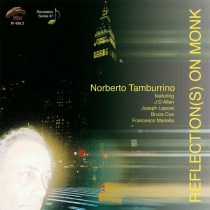
"Reflection(s)
on Monk"
|
|
-Review from WorldWide
Jazz Jan.
2011
"..The fires
of musical energy are felt in this album that translates into
a musical delight for the listener. Norberto projects
true love for jazz music through his playing and
has the right touch for jazz piano. Reflections(S)
On Monk needs to be in your jazz CD collection."
by Richard Henry
da
Musica Jazz,Agosto
'09 Italia
“...più che le strutture, per Tamburrino sembrano
avere importanza il lirismo di Thelonious e il modo in cui,
per un processo di assimilazione, è diventato un naturale
elemento della sua poetica. E sta proprio in questo il punto
di forza del disco.
by Giuseppe
Piacentino |
-Review from
All
About Jazz New York, July 2009
"..Tamburrino's Monkery shine broadly in
unreconstructed rag and stride motifs and genial, spiky liricism.." by Fred
Bouchard
-Review from online-jazz.net
“Prendere
come punto di riferimento la musica di Thelonious è una sfida
ardua per chiunque data la complessità insita nella musica
di questo straordinario pianista. Norberto, a mio avviso, l’ha
fatto nel miglior modo possibile,..”
by
Gerlando Gatto
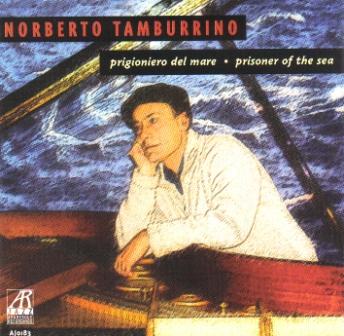
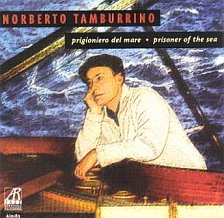
“Prisoner
of the Sea-Prigioniero del Mare”
(reviews)
Download Mp3
 From
All
About Jazz-Itay (21
May '08) From
All
About Jazz-Itay (21
May '08)
“.. In trio, Tamburrino miscela le raffinatezze armoniche
di Bill Evans con le asperità di T. Monk ottenendo un risultato
interessante grazie anche all’ottimo interplay con la ritmica
americana e alla completa padronanza degli ottantotto tasti.
Ma la situazione che definisce più compiutamente la poetica
del pianista pugliese è quella del piano solo. Cinque brevi
o brevissimi brani, quasi degli aforismi musicali nei quali la storia
del piano jazz viene filtrata da una marcata vena mediterranea.
Vengono qui esaltati il bel suono, l’attenzione ai particolari,
la precisione del tocco, lontani
da una scontata rivisitazione folklorica e focalizzati sullo sviluppo
armonioso delle composizioni..” by Vincenzo
Roggero
From
www.online-jazz.net -2008,
January (translated)
“.. I must say that already after listening to the first
album, certain of Tamburrino's characteristics had hit me, characteristics
that I found amplified in the new album which I don't hesitate
to define excellent, and for more than one reason. Most of all,
the artist from Puglia shows that he's a well-rounded musician
which makes one praise him under different aspects, principally
as a composer. As already mentioned, almost all of the pieces
are his and in writing them the artist demonstrates a very pleasant
quality, with elements of suggestive introspection which are found
everywhere. Particularly interesting, in this regard, Ocean
View and Tramonti
di Pioggia (Sunsets of Rain), whereas Prisoner of the
Sea
brings us into a mainstream territory presented however with originality
and thoughtfulness. Originality and thoughtfulness which we find
in Tamburrino's execution, who boasts of a solid base preparation,
a light touch but always swinging, a great facility for improvisation
and a particular harmonic richness. Starting with these premises,
you will already have understood that the album is listened to
with great interest from the first note also because, for once,
the material isn't "treated" but we hear it as we would
hear it live, except for Stars in Box in which Tamburrino's
piano is heard over a pre-registered base, composed of organ,
koto, violins and an electric piano.
by Gerlando Gatto

From Italian "Musica
Jazz"
-April '08
“Nell'immaginazione di Tamburrino c'è forse l'idea
che lo strumento sia come una grande nave, tutto votato com'è
agli interminati spazi, alla costruzione di un'atmosfera estatico-meditativa,
al gusto per le risonanze (correndo il rischio di uneccessivo uso
del pedale). Il trio è senz'altro ben affiatato e, lì
dove il leader dipinge colori evanescenti, c'è Cox a riequilibrare
verso una musica più viscerale. In Prigioniero del Mare la
partecipazione di un ottimo sassofonista come Allen arricchisce
il groove. Alla prima parte del disco succede quella in cui Tamburrino
si presenta in solitudine e approfondisce le proprie scelte per
concatenazioni armoniche ricche e mai scontate...”
by Daniele Mastrangelo
|
 |
from All
About Jazz-October 17, 2008
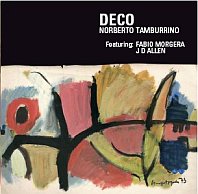
"...Tamburrino's piano playing, heavily
influenced by Thelonious Monk, is ripe with
percussive clatter and arpeggiated flourishes. Indeed, the
inclusion of Monk's overlooked ballad "We
See" demonstrates Tamburrino's thorough
understanding of the familiar nuances associated with the late
pianist..."
by John Barron |
review from Italian "Jazz
magazine" N° 58-
September '07
"E'
personaggio interessante, questo pianista della nuova onda di jazzisti
pugliesi che si divide tra movenze classicheggianti e zone franche
alla maniera Westoniana, cui aggiunge masticate
traiettorie vicine all'inevitabile Thelonious Monk....Piacciono
l'orientaleggiante "Come Mai" con la tromba sordinata
di Fabio Morgera e il bellisimo assolo di sax di
J. D. Allen " in Roxane". La gran parte
del cd lo vede però in solitudine al piano, pulito, intenso,
attento e spaziale.."
by L. T.
From Italian magazine "Musica Jazz"
-May '07-(translated)
“ From the first note Tamburrino let's
us understand that he doesn't want to follow overly used roads or
better to have already taken them but to have reserved for himself
the possibility to find new ones, some of which open to us new unedited
panoramas...The style is, at same time derived from classical concert
technique and African percussion, while the armonic-melodic development
tries to avoid bop cliche to create a less linear and more spaced,
that bring back motif of Randy Weston, Thelonious
Monk and Andrew Hill...”
by Aldo Gianolio
From web magazine "Suono.it" Jan.
'07
“ Per fortuna il jazz italiano continua a percorrere numerose
direzioni ed è sempre più semplice aver la possibilità
di ascoltare qualcosa che sia non necessariamente consuetudine.
Norberto Tamburrino realizza con questo lavoro
un progetto non facile di integrazione per diversi percorsi sonori
che lo riguardano"....… insomma, un discreto campionario
di situazioni ,generi e stili che lascia intuire da subito un ambito
d’ascolto piuttosto variegato. I rimandi a Monk,
nello stile, nella musicalità, nel tocco, nell’improvvisazione
come nelle scelte compositive, è evidente ben oltre l’omaggio
che al grande musicista viene reso da Tamburrino con We See, mentre
il resto delle composizioni è praticamente per intero opera
del titolare del lavoro..”.
by Pierluigi Zanzi
 |



 Join'
to Facebook
Join'
to Facebook